What FTIR Actually Tells You About a Formulation
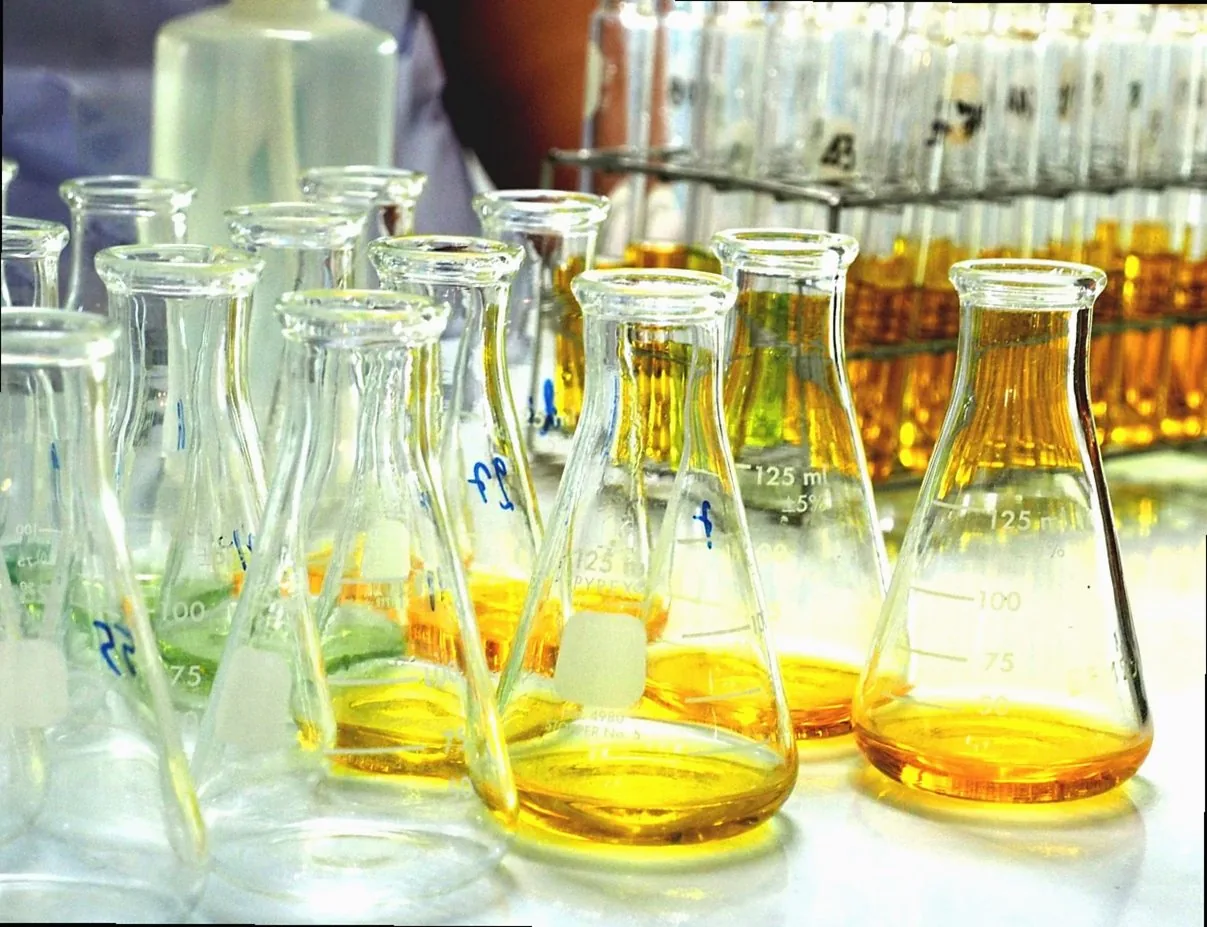
FTIR is one of the most common first tests run on an unknown or suspect sample. It is fast, non-destructive in most configurations, and produces a spectrum that can be compared against a library of reference compounds. But the output is often misread, and the limitations are rarely explained in the report itself. This article covers what FTIR actually measures, where it is reliable, and where you need a different method.
What the instrument measures
FTIR works by passing infrared light through or reflecting it off a sample and measuring which wavelengths are absorbed. Different chemical bonds absorb at characteristic frequencies, so the resulting spectrum is effectively a fingerprint of the bond types present in the material. A carbonyl group absorbs around 1700 wavenumbers. A hydroxyl group absorbs broadly around 3300. An aromatic ring leaves a pattern in the 1500-1600 region.
The spectrum does not tell you the exact molecule. It tells you which functional groups are present. From that, combined with library matching and analyst interpretation, you can usually identify the compound class and often the specific compound, provided it is in the reference library.
Where FTIR is reliable
For pure or near-pure substances, FTIR library matching is highly reliable. Polymers, solvents, common excipients, and many active ingredients have well-characterised spectra and match cleanly against commercial databases.
For mixtures, it is more complicated. The spectrum of a mixture is a superposition of all the components, and minor constituents below roughly 5% by weight may not produce visible peaks. FTIR can confirm the presence of a dominant component in a mixture, but it cannot give you a complete ingredient list from a single scan.
When to use a different method
If you need to identify volatile compounds, GC-MS is more appropriate. FTIR does not separate components before analysis, so volatiles and trace-level compounds are easily masked.
If you need elemental data (metals, for example), FTIR is the wrong tool entirely. It measures molecular bonds, not elemental composition. For metals, ICP-OES is the standard method.
If your question is about concentration rather than identity, FTIR can be used quantitatively but requires careful calibration against known standards. A qualitative FTIR report does not give you a percentage figure.
What a good FTIR report should include
The report should show the annotated spectrum, the library match result with a confidence score, the method used (ATR, transmission, or diffuse reflectance), and any analyst notes on ambiguous peaks or alternative interpretations. If the report gives you only a compound name and a tick, it is not giving you enough to evaluate the result yourself.
At Bold Mirage Lab, every FTIR report includes the raw spectrum as an image, the top three library matches with scores, and a written interpretation. If the match is ambiguous, that is stated explicitly rather than resolved by picking the highest-scoring result.
FTIR is a useful starting point, not a final answer. Knowing what it can and cannot tell you helps you ask the right follow-up question.